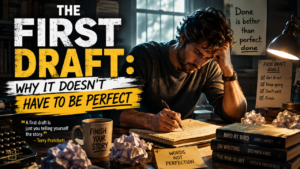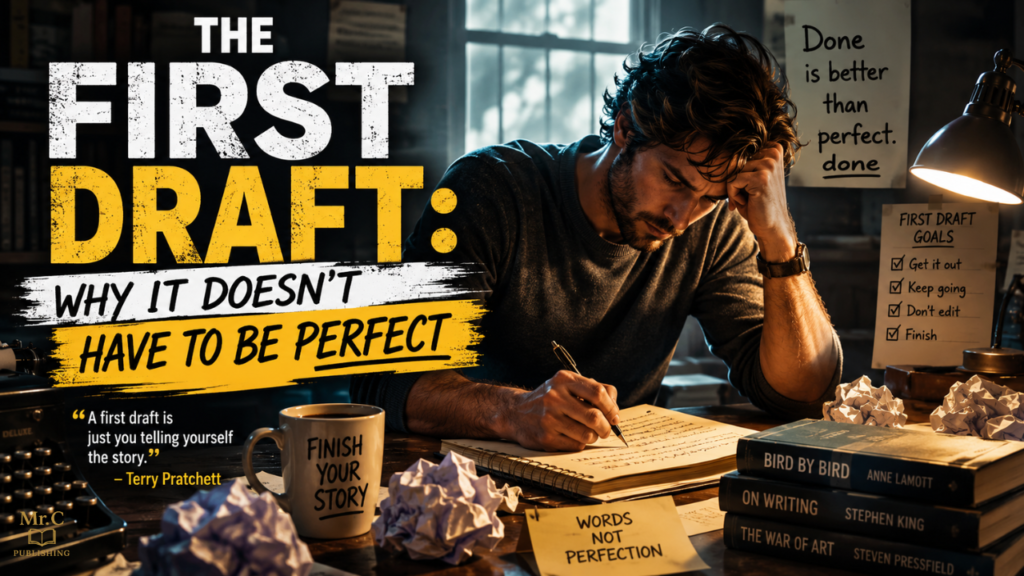
The First Draft: Why It Doesn’t Have to Be Perfect
Every writer knows the feeling.
You sit down with excitement, open a blank page, write the first paragraph… then immediately delete it.
The opening isn’t strong enough.
The dialogue feels forced.
The description sounds flat.
Maybe the idea wasn’t that good after all.
A few minutes later, you’re no longer writing a story—you’re editing one that doesn’t exist yet.
This is one of the biggest reasons aspiring authors never finish their first book. They believe a first draft should already resemble a finished novel. In reality, the first draft has a completely different purpose.
Its job isn’t to be beautiful.
Its job is to exist.
Why Perfection Stops More Books Than Lack of Talent
Many people assume successful authors write flawless pages from the beginning.
They don’t.
What separates experienced writers from beginners isn’t that professionals make fewer mistakes. It’s that they understand mistakes belong in the first draft.
Perfectionism creates an impossible standard. Every sentence is judged before the next one is written. Every chapter is rewritten before the story has a chance to unfold.
The result isn’t better writing.
It’s less writing.
A novel cannot be edited until it exists.
Your First Draft Is a Discovery Process
Think of your first draft as exploring unfamiliar territory.
You may know where your story begins and where it ends, but you don’t yet know every conversation, every emotional moment, or every surprise waiting between those two points.
Characters often reveal unexpected traits.
Relationships grow in directions you didn’t plan.
Scenes that seemed essential disappear, while small moments become unforgettable.
These discoveries only happen when you keep moving forward.
If you stop to polish every page, you interrupt the creative process before it has a chance to surprise you.
Writing isn’t just recording ideas.
It’s finding them.

Drafting and Editing Are Two Different Jobs
Imagine asking a sculptor to polish marble before carving the statue.
It sounds absurd because there’s nothing to polish yet.
Writing works the same way.
Drafting is creation.
Editing is refinement.
Trying to do both at once forces your creative mind and critical mind to compete for attention. One wants to invent possibilities. The other wants to eliminate imperfections.
They rarely work well together.
When drafting, give yourself permission to write awkward sentences, weak dialogue, and unfinished descriptions.
You’ll return later with fresh eyes and make them stronger.
Every Great Novel Started as an Imperfect Draft
Readers remember finished books.
They never see the countless revisions behind them.
Behind every bestselling novel are deleted chapters, rewritten endings, abandoned characters, and scenes that never reached publication.
The polished version exists because an imperfect version came first.
The first draft isn’t proof of your ability.
It’s the raw material your ability transforms.
Practical Ways to Finish Your First Draft
Instead of chasing perfection, build momentum.
Set small writing goals. Writing 500 words every day is more powerful than waiting for a perfect weekend.
Resist the urge to reread constantly. Looking backward too often slows your progress forward.
Leave notes instead of fixing problems. If something doesn’t work, write yourself a quick reminder and keep going.
“Research this later.”
“Rewrite this conversation.”
“Find a better character name.”
Your future editing sessions will thank you.
Celebrate completion, not perfection.
A finished imperfect manuscript can become an excellent novel.
An unfinished perfect chapter never will.
The Hidden Purpose of the First Draft
The first draft isn’t just about producing pages.
It’s about becoming the writer capable of finishing a book.
You learn pacing by writing chapters.
You learn dialogue by writing conversations.
You learn storytelling by telling stories.
No outline, podcast, or writing course can replace the lessons learned from completing an entire manuscript.
The first draft teaches skills that only writing itself can teach.
Final Thoughts
Many writers dream about publishing a novel.
Far fewer finish one.
The difference often has nothing to do with talent.
It comes down to permission—the permission to write badly before writing well.
Your first draft isn’t your final statement as a writer.
It’s your first conversation with the story.
Let it be messy.
Let it surprise you.
Most importantly, let it be finished.
Because every memorable novel begins the same way:
With a writer willing to write imperfectly.
Recommended Books