Show, Don’t Tell: What It Really Means
Introduction
“Show, don’t tell.”
It’s one of the most common pieces of writing advice ever given.
And one of the most misunderstood.
Many new writers believe it means describing everything in great detail.
It doesn’t.
Showing isn’t about writing more.
It’s about helping readers experience the story instead of simply being told what happens.
Let’s explore what “show, don’t tell” really means—and when telling is actually the better choice.
What Does “Show” Mean?
One of the biggest mistakes writers make is creating a flawless hero.
Perfect characters rarely surprise us.
They rarely struggle.
And without struggle, theImagine reading this sentence:
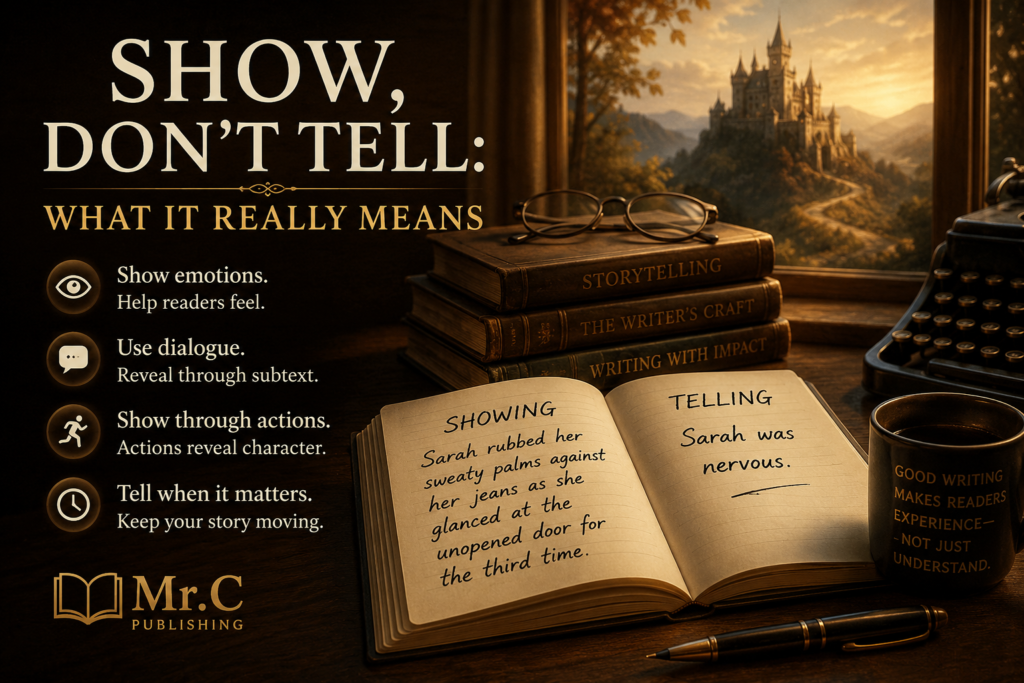
Sarah was nervous.
You understand it immediately.
But you don’t feel it.
Now consider this:
Sarah rubbed her sweaty palms against her jeans as she glanced at the unopened door for the third time.
Nothing says she’s nervous.
Yet the reader experiences it.
That’s showing.

What Does “Tell” Mean?
Telling summarizes information.
For example:
They traveled for three days before reaching the castle.
There’s nothing wrong with that.
Not every moment needs to be dramatized.
Sometimes moving the story forward is exactly what readers need.
Show Emotions
Readers connect through emotion.
Instead of saying:
He was angry.
Try:
His jaw tightened.
His fists curled at his sides.
He struggled to keep his voice steady.
The emotion becomes something readers witness.
Show Through Dialogue
People rarely say exactly what they mean.
Subtext creates realism.
Instead of:
“I’m jealous.”
Try:
“Funny how you suddenly have time for everyone else.”
The feeling is clear without being stated directly.
Show Through Actions
Actions reveal character better than descriptions.
Anyone can claim to be brave.
A brave character acts despite fear.
Readers believe behavior far more than labels.
When Telling Is Better
Not every sentence should show.
If every page described every movement, stories would become exhausting.
Use telling to:
- Move time forward.
- Transition between scenes.
- Summarize unimportant events.
- Keep the story moving.
Great writing balances both.
Final Thoughts
Showing helps readers live inside a story.
Telling helps stories keep moving.
The best writers know when to use each.
Mastering that balance transforms ordinary writing into unforgettable storytelling.
Recommended Reading